

From Space Mirrors to Native 6G Integration: EURA Charts the Four-Stage Evolution of Direct-to-Cell Satellite Connectivity
Driven by the rapid convergence of aerospace and telecommunications, non-terrestrial networks (NTN) are reshaping the global connectivity landscape. Once heavily reliant on bulky, specialized satellite phones, the ability to send texts, share data, and make video calls from remote regions or open oceans is quickly becoming a native feature of everyday smartphones. At the heart of this planetary transformation is the relentless evolution of the 3GPP NTN standards.
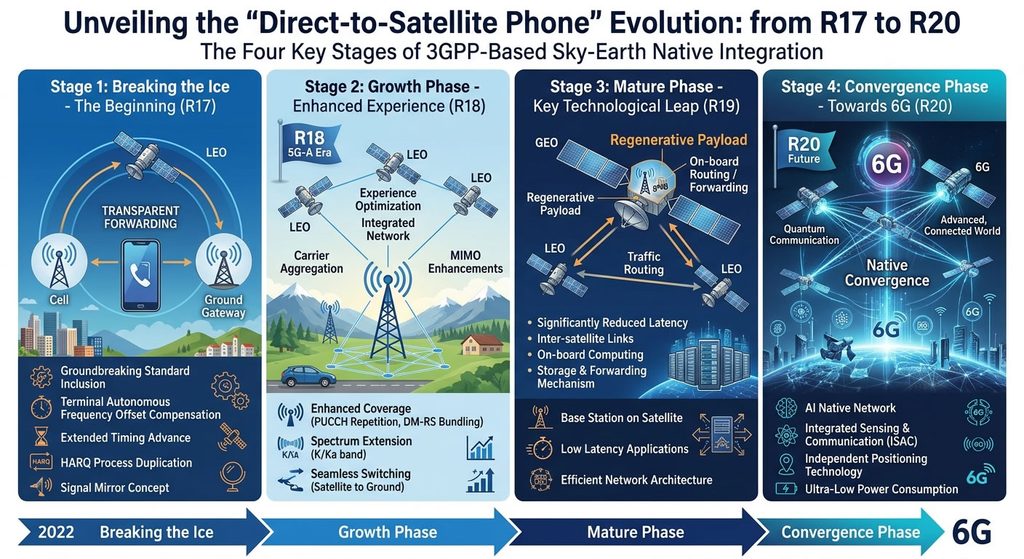
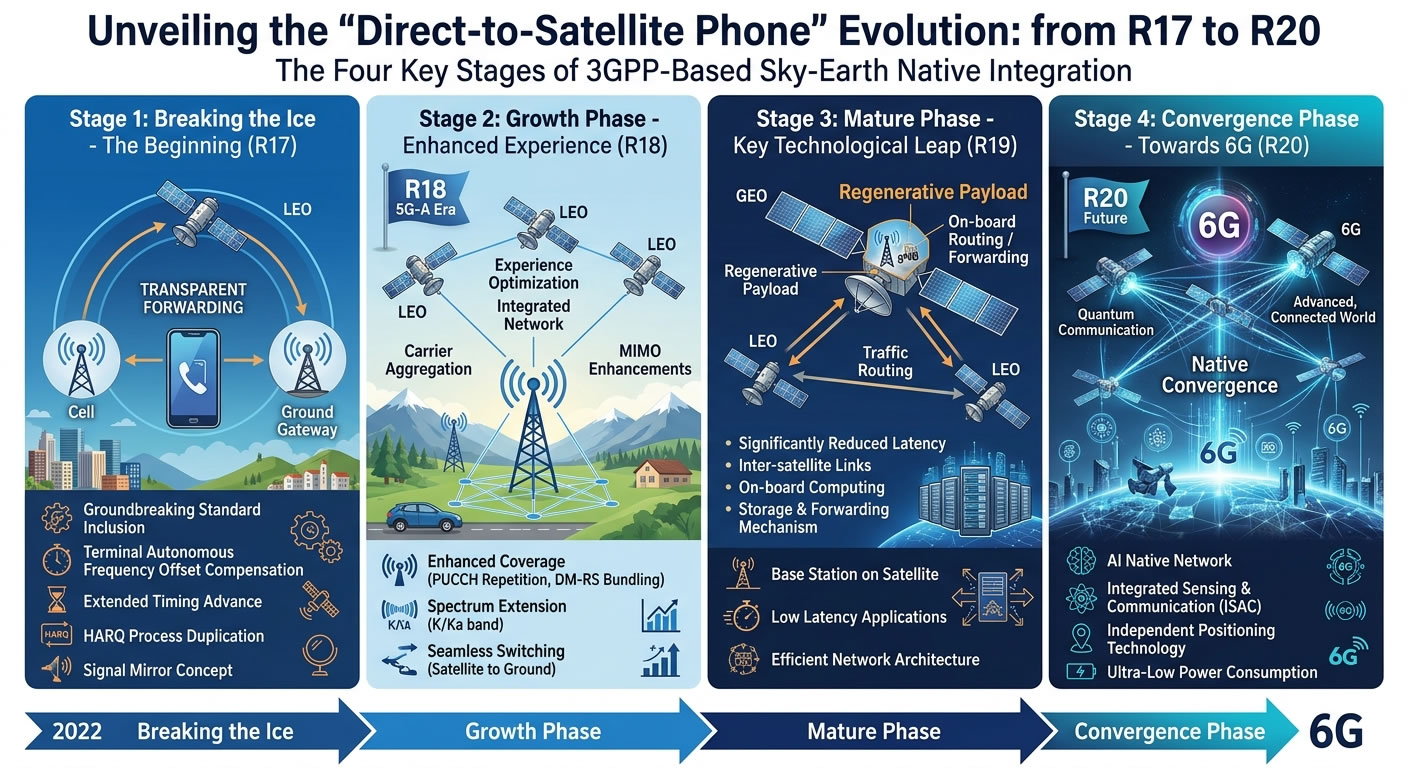
To help industry partners, enterprises, and media navigate this paradigm shift, EURA has unveiled a comprehensive technological blueprint charting the four critical stages of Direct-to-Cell evolution—spanning from 3GPP Release 17 to Release 20.
This technological roadmap details how satellite connectivity is evolving from an isolated emergency backup into a unified, native extension of global cellular networks.
The Four Defining Eras of Direct-to-Cell Evolution
- Stage 1: Breaking the Ice (3GPP R17) – Groundbreaking Standard Inclusion
Frozen in June 2022, Release 17 achieved a historic first by bringing satellite communication into the mainstream 5G NR and IoT protocols. Operating under a “Transparent Forwarding” architecture, satellites acted essentially as orbital mirrors, bouncing signals back to earth. R17 introduced crucial terminal-side innovations, enabling standard phones to autonomously compensate for Doppler shifts via GNSS data, doubling HARQ processes, and extending timing advance parameters to handle the massive 540ms round-trip latency of GEO satellites. - Stage 2: Growth Phase (3GPP R18) – Enhanced Experience & Seamless Switching
As the industry transitioned into the 5G-Advanced era, Release 18 shifted its focus from basic connectivity to robust user experience. Through a trio of coverage enhancement techniques—including PUCCH repetition, DM-RS bundling, and optional HARQ deactivation—R18 significantly improved transmission reliability in weak-signal areas. Furthermore, expanding the spectrum into the K/Ka bands unlocked higher bandwidth, while native, seamless switching between terrestrial networks and satellites eliminated the frustration of dropped sessions during transit. - Stage 3: Mature Phase (3GPP R19) – Regenerative Payload & Base Station on Satellite
Release 19 marks a profound architectural leap by turning the satellite itself into a fully operational network node. Through regenerative payloads, complete Next-Generation NodeB (gNB) base stations are deployed directly in space. Supported by advanced inter-satellite links (ISL), data traffic can be dynamically routed within the constellation without relying constantly on ground gateways. This drastically lowers end-to-end latency, multiplies network capacity, and introduces store-and-forward mechanisms that keep
communications alive even under non-continuous satellite coverage. - Stage 4: Convergence Phase (3GPP R20) – Native Space-Earth Integration & The Bridge to 6G
Serving as the ultimate bridge to the next generation of connectivity, Release 20 merges 5G NTN enhancements with foundational 6G architecture. In this phase, satellite and terrestrial infrastructures cease to be separate systems, melting into a single, native network. Key innovations include AI-native network stacks embedding intelligence at every layer, Integrated Sensing and Communication (ISAC) giving the network environment-awareness, standalone positioning independent of GNSS, and an aggressive energy target cutting power consumption per bit to just one percent.
Connecting the Unconnected
“Direct-to-Cell technology is no longer just a premium niche feature or a temporary patch for cellular blind spots,” said the Executive Team at EURA. “It is the natural, three-dimensional evolution of mobile networks. By tracking and actively analyzing these 3GPP standards, we are laying the foundational knowledge needed to empower global businesses and consumers with the ultimate assurance of being ‘always connected,’ no matter where they are on Earth.”
As an ambitious new voice entering the next-generation communication landscape, EURA remains dedicated to tracking the progress of satellite operators, telecom carriers, and hardware ecosystems to help accelerate the realization of a truly seamless, native space-earth network.
For more technical insights or to download the high-resolution infographic, please visit our official website at [www.euraai.com].