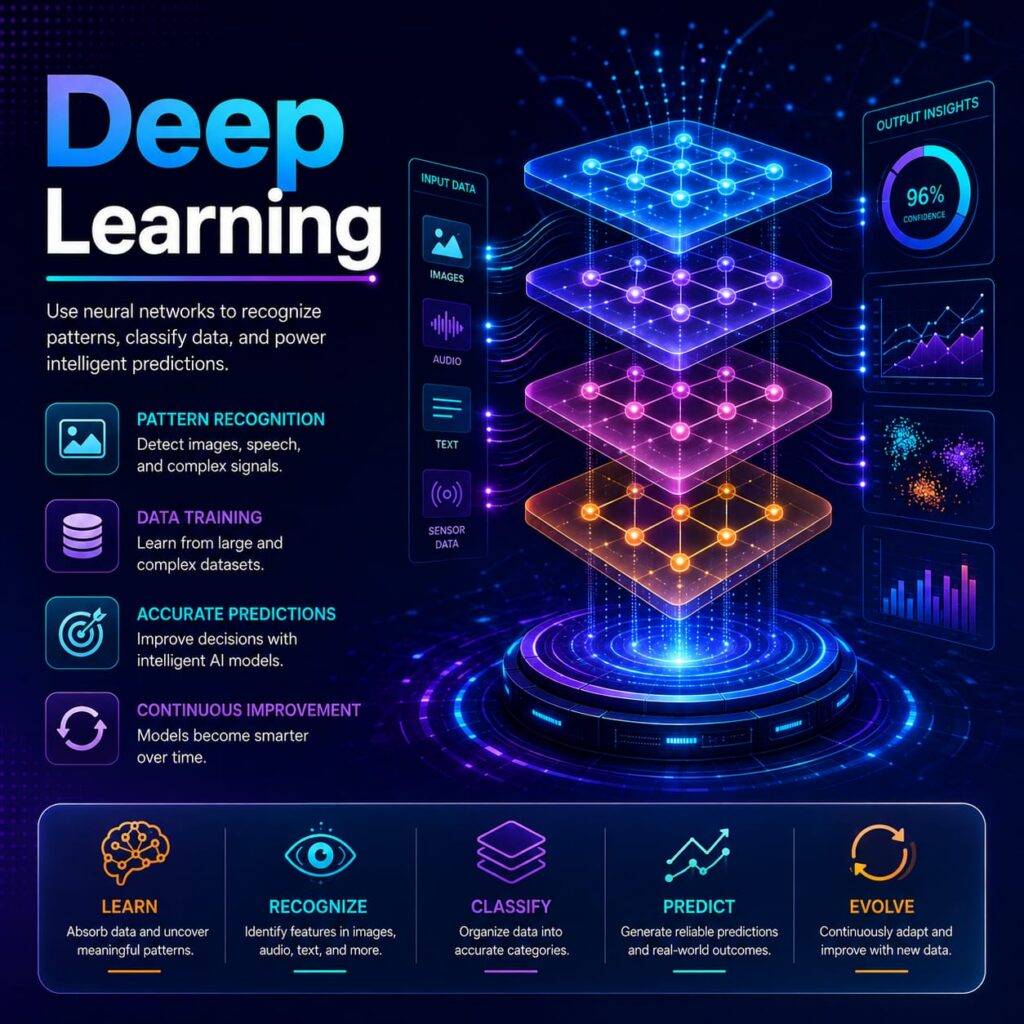
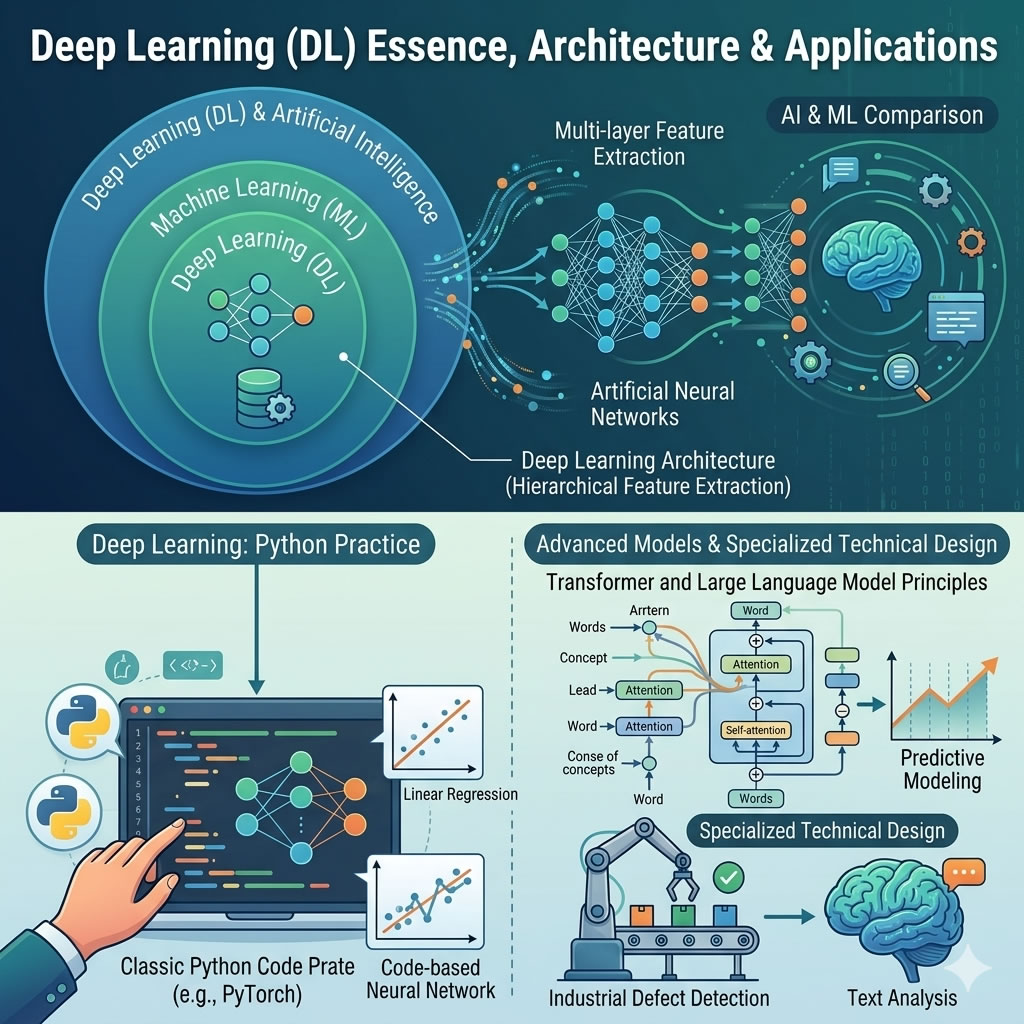

Deep learning is a subfield of artificial intelligence (AI) and machine learning (ML). It enables computers to learn and extract features from large amounts of complex data, much like the human brain, by building and training multi-layered artificial neural networks.
Core Architectures: Depending on the type of data being processed and the application scenario, deep learning primarily relies on the following core network models:
- Convolutional Neural Networks (CNNs): Designed specifically for processing gridded data (such as images and videos), they automatically extract spatial features through convolutional layers and are the cornerstone of computer vision (CV).
- Recurrent Neural Networks (RNNs) & LSTMs: Possessing memory capabilities, they can process sequential data with sequential relationships and are commonly used for time series prediction.
- Transformer Architecture: The absolute core of modern AI, utilizing self-attention mechanisms to process extremely long texts simultaneously and serving as the underlying logic for various large language models (LLMs).
- Generative Adversarial Networks (GANs) / Diffusion Models: These models use a game-like interaction between a generator and a discriminator, or involve noise addition and denoising, to generate highly realistic images, audio, or video.
Key Applications
- Computer Vision (CV): Includes facial recognition for mobile phones, AI-assisted medical image diagnosis in hospitals, and real-time road condition and pedestrian recognition in self-driving cars.
- Natural Language Processing (NLP): Powers intelligent chatbots like ChatGPT, real-time cross-language machine translation, and automatic summarization of long texts.
- Speech and Audio: Supports Automatic Speech Recognition (ASR) for smart speakers, and Text-to-Speech (TTS) technology that converts text into natural human speech.
- Science and Prediction: AlphaFold for predicting the three-dimensional structure of proteins, or for accurate short-term weather forecasting and financial market fraud detection.
Advantages and Challenges of Deep Learning
- Core Advantages: Traditional machine learning requires experts to manually extract data features; deep learning, on the other hand, enables end-to-end learning, meaning the larger the dataset, the higher the model’s accuracy and upper limit.
- Significant Challenges: It is a “black box model,” with its internal decision-making process extremely difficult to interpret; furthermore, training large models requires massive amounts of labeled data and extremely expensive GPU computing power.