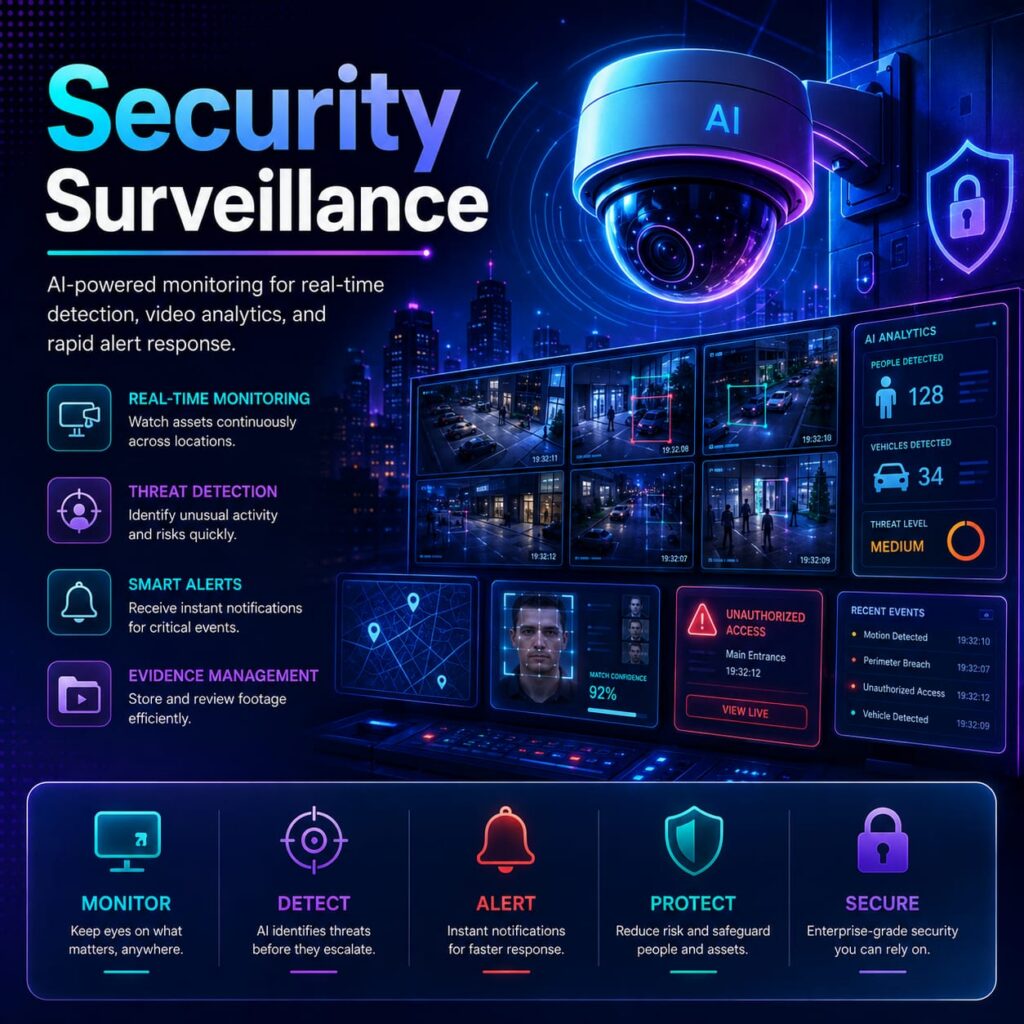

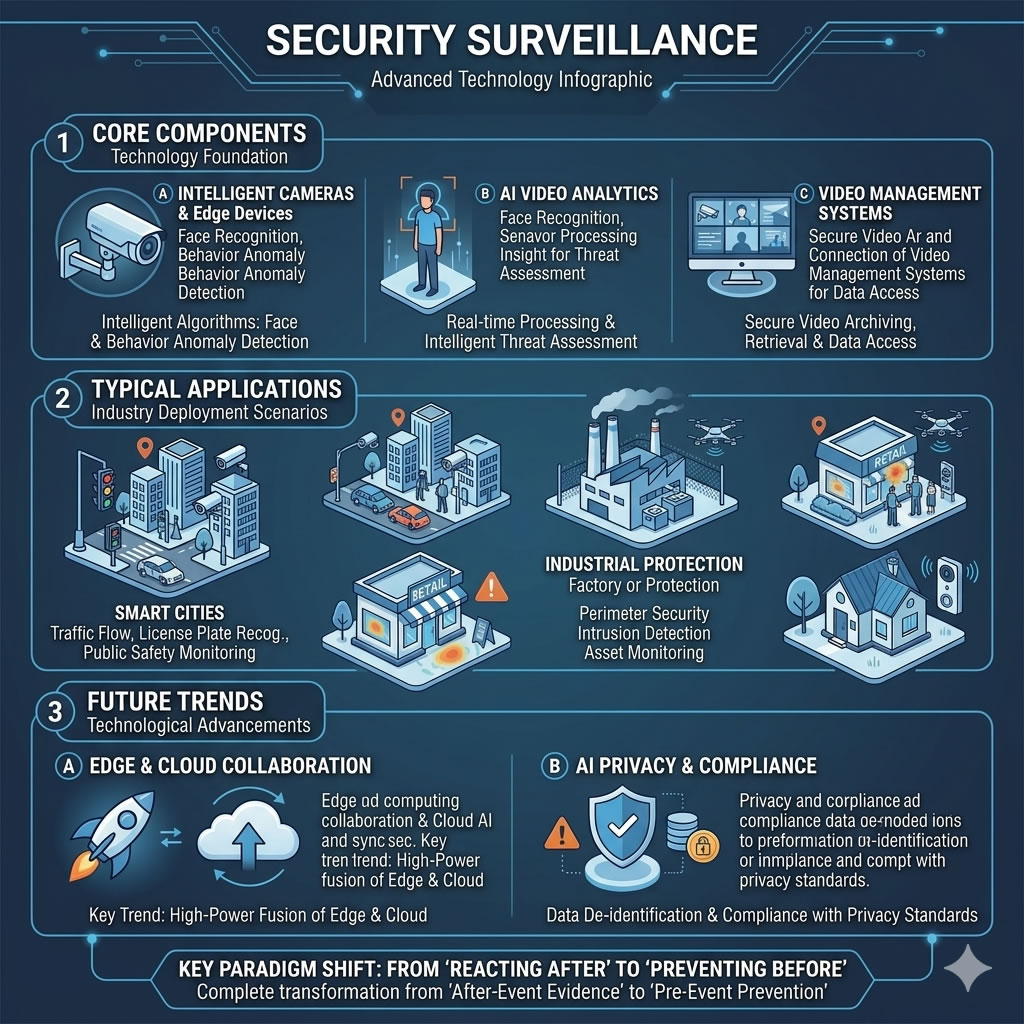

Security surveillance refers to a comprehensive defense mechanism that uses closed-circuit television (CCTV), sensors, alarms, access control systems, and artificial intelligence video analytics to monitor, record, and warn of threats to specific physical areas or digital systems in real time. In modern intelligent security, security surveillance is undergoing a complete transformation from traditional “post-incident evidence collection” to AI-driven “prevention and real-time interception.”
Core Technology Components
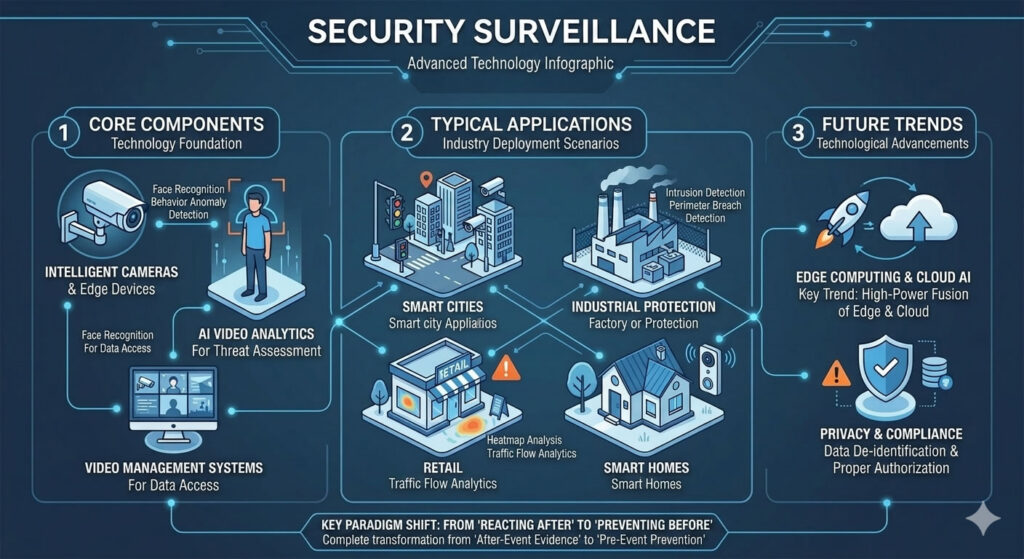
Based on the architecture and application level of the security system, security surveillance mainly consists of the following core components:
- Intelligent Cameras and Edge Devices: Includes high-definition network cameras (IP cameras), sensors supporting night vision and thermal imaging, and intelligent bullet cameras that can run deep learning algorithms directly at the edge, enabling extremely low-latency localized data processing.
- AI Video Analytics: Gives traditional surveillance systems “human-like understanding,” automatically performing face recognition (Face Recognition), license plate recognition (LPR), abnormal behavior detection (such as climbing, falling), and accurate pedestrian flow statistics.
- Video Management System (VMS): Acting as the brain of the surveillance system, it centrally manages the real-time scheduling of multiple video streams, cloud or local storage, and seamlessly integrates with the comprehensive dispatch and command center.
- Internet of Things (IoT) and Multi-Source Sensor Linkage: Integrates video surveillance with infrared security walls, smoke detectors, and smart access control systems to form a three-dimensional “defense-in-depth” system.
Typical Application Scenarios
- Smart Cities and Public Safety: Deploying cloud-based joint monitoring networks in transportation hubs and core business districts enables automatic capture of vehicle violations, crowd congestion warnings, and near-instantaneous response to public emergencies.
- Industrial and High-Risk Asset Protection: Deeply penetrating unmanned areas such as chemical plants and substations, it uses perimeter intrusion detection to prevent unauthorized entry and thermal imaging technology to monitor abnormal equipment temperatures in real time to prevent fires.
- Commercial Retail and Space Operation: Beyond theft prevention, the monitoring system generates heat maps and analyzes customer flow to help businesses optimize shelf displays, improve space efficiency, and manage peak customer traffic.
- Smart Home Security: Consumer-grade smart peepholes and outdoor surveillance cameras support 24/7 human/pet recognition and real-time app push notifications, allowing users to monitor home security anytime, anywhere.
Technology Evolution Trends
- Core Trend: Surveillance systems are deeply integrating with cloud AI and edge computing. Edge devices handle rapid filtering and feature extraction, while the cloud handles big data accumulation and cross-regional correlation analysis, significantly reducing transmission bandwidth and improving response speed.
- Privacy and Compliance: With increasingly stringent regulations (such as GDPR) on personal privacy protection in many regions, modern security systems deploying facial recognition must strictly adhere to data anonymization, encrypted storage, and compliant authorization.